Tag Archives: WordPress

Pros and Cons of Using WordPress

I began my career many years ago as a mainframe COBOL programmer.  One of the hardest parts about programming on the mainframe was creating the user interface; consequently, an industry soon sprang up to create software which would automatically generate the code for the user interface.  The programmer then just had to write the unique business function code required for that particular application.  This greatly simplified the task of programming, as long as all your applications were similar and easily fit into the functions of the standard user interface code which was generated.  In the 21st century things haven’t changed all that much.  There are many software packages designed to automate or simplify specific programming tasks.  As long as you keep your designs simple and follow their paradigm things work very well.  Unfortunately, in the real world users don’t always want simple designs and they definitely don’t always want to follow prescribed processes or paradigms; they often want to create something unique and all their own.

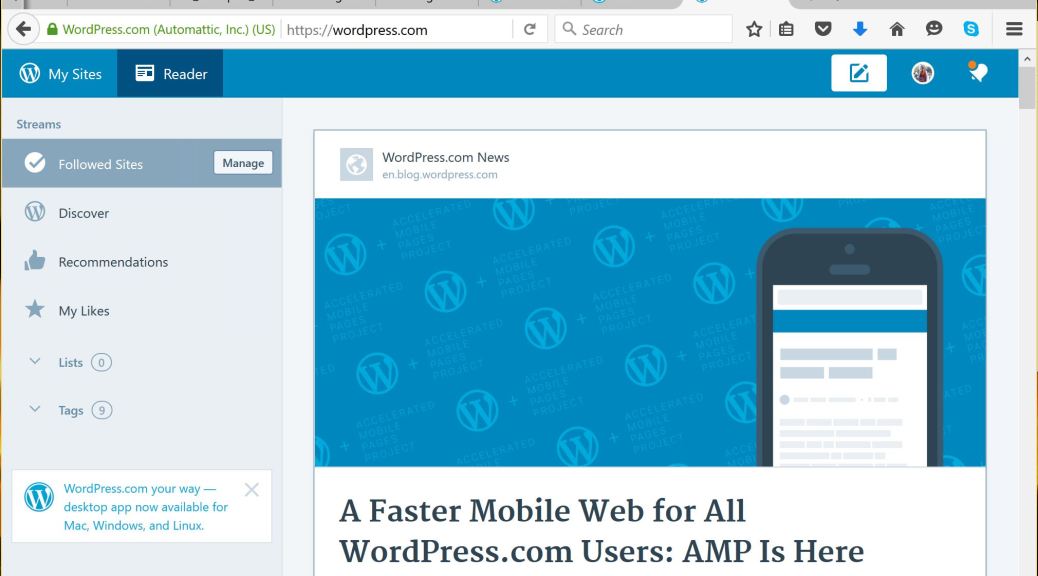
Thus it is with WordPress.  I love the simplicity with which I can quickly throw some words and pictures together and crank out a simple blog post.  The software is tailored directly for this particular process and enables a beginner to quickly come up to speed and set up a blogging site with little training.  If you don’t like style of your blog, you can experiment with the many free templates or even invest in a premium template to get the look that you want.

Unfortunately, when you start trying to move beyond mere blogging, things can become more difficult.  Several years ago, my sons decided to create a charity bike ride for a friend of theirs who had Ehlers-Danlos Syndrome.  I had this brilliant idea, that I could quickly throw up a WordPress site so they could not only blog their trip, but collect pledges/donations from people on a per mile basis (http://twelvenineride.org/2014/07/16/day-1-a-bumpy-ride/).  I found a theme and threw in a twitter plug-in which allowed them to tweet from the road so that people could see their progress in real-time.  Everything was going pretty well until I tried to add in the e-commerce donation piece.  I remember spending several late nights and early morning hours working on it.  I wanted people to be able to click on the donation amount in a table based on a per mile figure and pass that amount directly into the donation page.  I passed the amount to the donation page but it would never show up in the donation amount box, so I ended up displaying the table and just putting a “Donate” button underneath it that took you to the donation page where you had to key in the donation amount.  In the end it worked well enough to raise about $8,000; nevertheless, it left me feeling very frustrated that I couldn’t get it to behave exactly like I wanted it to.

I think for small to possibly some medium size businesses that WordPress can be a good choice if you’re willing to adjust to its quirks.  For a larger enterprise or a small business with a picky owner that wanted his website to look or behave just so, I probably won’t recommend it.




Blogging Platform Recommendations for Three Scenarios

Blog Key

There is no such thing as a one-size-fits-all blogging platform.  Different scenarios call for different solutions; consequently, it is important for the aspiring blogger to carefully consider his or her options.  To illustrate, let’s look at three different potential bloggers and which solution(s) would be a good fit for them:

1. A giant coffee retailer looking to connect with customers.

Ice Coffee
Image: FreeDigitalPhotos.net

A large corporation values and is willing to pay for a more customized and professional looking blogging platform as well as enhanced technical support.  If there are money, resource, and/or time contraints, I would recommend that they choose a commercial blogging hosting site such as Expression Engine or Compendium Blogware.  Both platforms offer standard and custom blogging features beyond what WordPress, Blogger, or Tumblr  offer. 

Alternatively, as a large corporation with presumably vast resources and fewer money, resource, or time constraints than an individual blogger, they could purchase their own blogging software (most likely as part of a larger “Social Software” package) and host it themselves.  This would give them complete control over the hosting platform as well as the blogging site. 

Here are some highlighted features which might lead you to chose one platform/package over another:

2. A photographer interested in making their work go viral.

Man photographing sunset
Image: FreeDigitalPhotos.net

A photographer should look first to Tumblr to see if it meets their needs.  Tumblr caters to “creative types”, and is easy to use.  It also uses its homepage to broadcast the latest works created by its members and offers some categorization of content by category type.

If the photographer specializes in video, he/she would probably want to post the video to YouTube and link to it from his/her blog in order to increase its visibility and maximize the chance that it will go viral.

3. A Syracuse Crunch hockey blogger looking to write daily updates.

Hockey Player
Image: Wikimedia Commons Author: Jshecket

A minor league hockey player wishing to write daily updates would probably be best served by selecting WorkPress or Blogger as their blogging platform.  The cost and technical skills required to create and post to the blog are minimal.  Search engine optimization is done automatically by the hosting platforms and mobile applications are available to make it easy to post while “on the road”.   WordPress would be my first choice due to its greater popularity in the blog world.  However, if integration with other Google services (e.g. Google docs) was an important concern, Blogger would be the better choice.

WordPress vs. Tumbler Blog Platform Comparison

WordPress or Tumblr
Image: FreeDigitalPhotos.net       

WordPress and Tumblr both seem to offer beginning bloggers an easy entrypoint  into the blogsphere; however, upon deeper reflection, one can see that there are more differences than similarities.

  • WordPress seems to attract people who like the written word.  Photos and videos are supported and used by WordPress bloggers, but one gets the impression that these are supplements to the written blog.  Some blogs even seem to eschew  pictures and video, offering word only posts. Tumblr on the other hand, seems to attract people who want to communicate primarily through photos and videos.  Often, the images posted are followed by only short, twitter-like explanations of the posting.
  • Tumblr focuses on attracting visual creative types.    With it’s tagline, “follow the world’s creators”, its target audience is narrower and more clearly delinated than WordPress.  Just showing up at its homepage plunges the visitor into a plethora of overwhelming visual stimulation which one does not find on the “plain Jane” WordPress homepage.
  • WordPress allows for more customization.  Tumblr’s simplicity, while good for beginning bloggers, does not necessarily lend itself well to the complex editing and features that more advanced users may desire.  By paying for the stand alone version of WordPress you can upgrade, create your own URL, and even add eCommerce functionality if you want avoid “starving artist” status. 

In summary, Tumblr is a better platform for visual, creative types who are just beginning to blog or who favor a simple, easy-to-use interface to exhibit their creative works.  WordPress is a better platform for those focused on written expression or for those who want to exert more technical control over their blog.  Upgrading to the stand alone version of WorkPress, allows additional control and provides a growth path for those who have outgrown the free versions of WordPress and Tumblr.