What Happens when Tiny Seedlings Grow into Large Trees

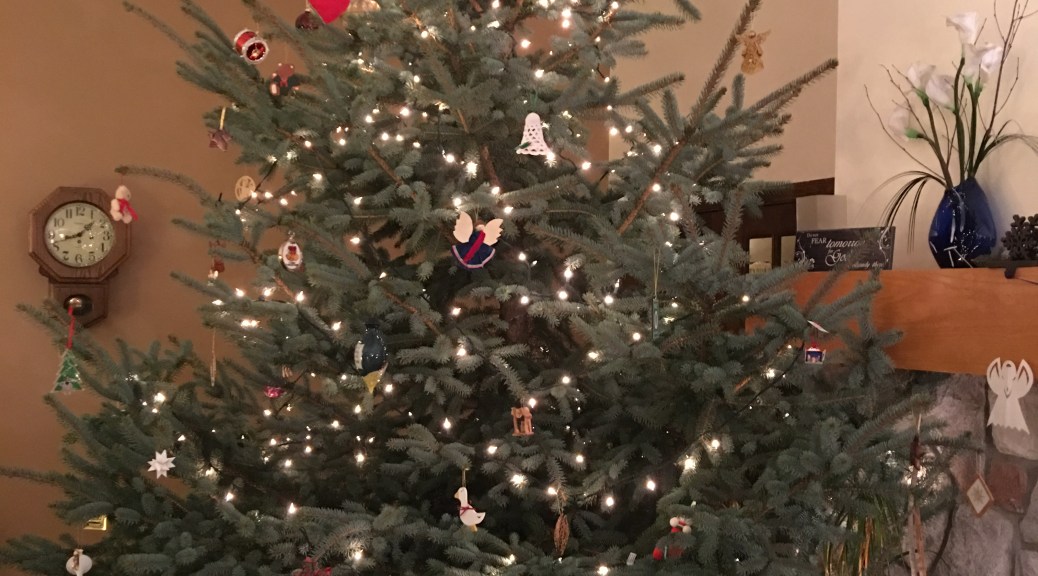
Soon after we purchased our current home 23 years ago, we planted some small pine trees in the backyard at the edge of our property.  Over the years these trees grew and began to encroach upon each other.  About 10 years ago, we decided that it was time to begin thinning the trees and decided to harvest one as a Christmas tree.  I treked to the end of our lot with our kids and we took turns sawing on the trunk with a hand saw until we were able to fell the tree.  While the tree had looked rather small from the windows in our home, we suddenly realized that it was much larger and heavier than expected.  We had difficulty dragging it up the hill to our house, so we found a tarp to roll it onto and used that to slide it up from our backyard into our driveway.  Once in the driveway, we were within range of a power outlet and used the electric saw to further trim the tree down to size.  Unfortunately, when we tried to bring it in through the back garage door, it still didn’t fit the doorway.  Eventually, we decided to try bringing it in the larger front door, which also gave us the advantage of being a straight shot into the family room so we wouldn’t have to “bend” the tree around corners.  After much pushing and shoving, we were able to ram the tree through the front door and up the stairs into the family room.  We then hoisted the tree into an upright position, only to find that it was still too tall and scraped the ceiling at the peak of our 14 foot cathedral ceilings.  At that point we lowered the tree and took the electric saw to it again (inside the house, no less) until we had shortened it enough that we could hoist it upright without making marks on the ceiling.   As I remember there were additional difficulties keeping it upright and in place once we got it positioned, but all in all, my kids loved the tree preparation process, enjoyed decorating the tree, and lighting it up every night during the Christmas season.

Ten years later only two of our four children still live at home, and my wife had purchased a synthetic tree to use this year.  However, one Saturday when my wife and I were out running errands, one of our married daughters came home for the weekend with her husband and some friends, and decided that the ritual must continue.  When my wife and I arrived home, the yard and the driveway were strewn with extraneous tree limbs.  In spite of the fact that they had measured the tree first (a new mandatory process which we adopted after the first year), they had still overshot the ceiling and had to do additional emergency surgery to get the tree to fit.  Nevertheless, they managed to complete the job and once again we have a floor to ceiling length Christmas tree gracing our family room.

As I reflect upon what I learned this semester in my digital communications class, I was reminded of how my original small flip phone has grown into a giant iPhone 6s Plus that I can barely get in and out of my pocket.  A device that seemed rather small and inconsequential at the time has morphed into something that consumes my attention a good part of each day.  The latest news, stock reports, and weekly download of the Economist magazine distract me and captivate my attention way too much on an hourly basis.  I plan less and just react more.  I don’t need to know how to get anywhere, just fire up the map app, plug in an address, and I’ll get there without any planning, …..well……. most of the time anyway.  As the year draws to a close, I resolve that even though we didn’t downsize the tree this year, there’s still an opportunity to downsize my phone, or at least the obsessive, incessant checking of the latest notifications.  It’s important to set it aside more and allow myself time to plan and organize my life.  It’s important to stay focused on the many other truly important tasks that need to be completed by the year’s end.  And, finally, it’s most important of all to spend more time each night sitting on the couch, admiring the tree, and contemplating the real meaning of the Christmas season.
Ads, Ads, Everywhere, even on Mobile

While my mobile phone used to be an almost ad-free zone.  It has suddenly turned into a virtual ad machine.  Several of my news applications now slip advertisements in between their stories.  When I scroll through the news articles looking for something to read, this makes it easy to accidently touch and activate the advertisement, kicking me out of the application and into my mobile web browser.  Needless to say this does not endear the advertiser or the news app provider to me.  Some news apps put most of their advertisements at the bottom of the screen of news articles.  This is a better arrangement for me as a consumer; however, I don’t always scroll to the bottom of the page; consequently, I doubt that these ads get as many views as the embedded ones.

While my Safari “Block Cookies” setting is “Allow from Websites I Visit”, the advertisements that I receive seem significantly less targeted than the ones I receive on my PC.  I never thought it would happen, but I miss having advertisements in which I have at least some semblance of interest.  Nevertheless, I don’t miss getting the same advertisement over and over for those products that I have already purchased.

My favorite mobile advertisements are still the ones that use geolocation to notify me of a discount at a nearby store.  Unfortunately, these still seem to be pretty rare, and again, they can’t tell if you’ve already bought the item or already eaten somewhere else; consequently, they’re not as useful as I’d like.

Right now there seem to be a lot of growing pains with mobile advertisements, but I’m hopeful that between the information that I choose to share and the use of big data on the seller’s end, I will see tailored advertisements and discounts.  Then viewing those advertisements will be worth my time and they can quit hiding out in my newsfeed waiting for me to accidently click on them.


How Traditional Journalism is like Old Technology

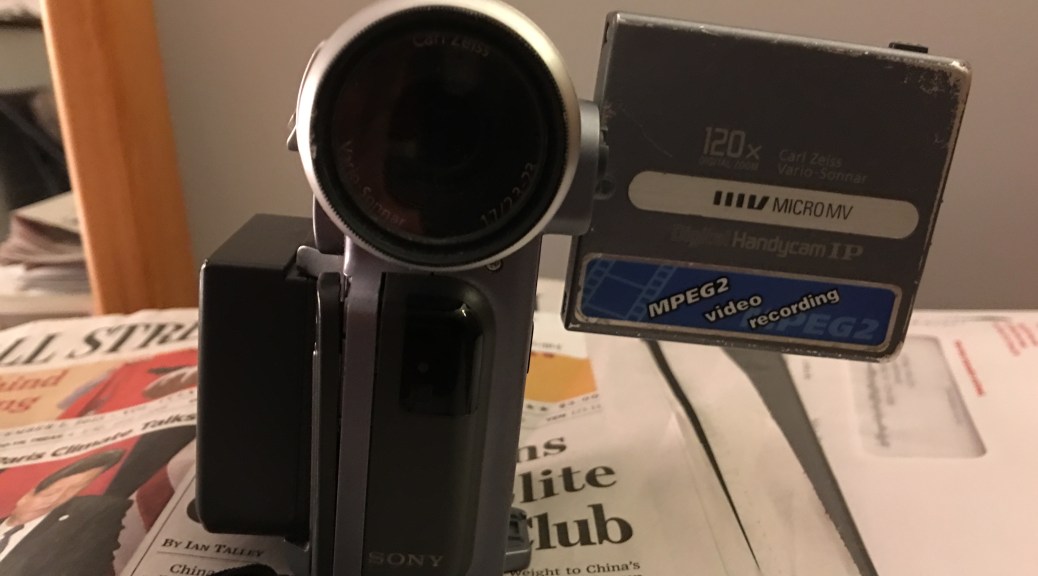
I bought my then state-of-the art SONY Micro MV camcorder approximately 15 years ago.  I had a difficult time choosing between it and a cheaper, bigger camcorder, that would have produced higher quality video.  In the end I decided to pay the premium to get the smaller camera and sacrifice some video quality, because I reasoned if it wasn’t small enough to take with me, I wouldn’t use it.   It came with a sleek “one hour” battery, which really lasted closer to 45 minutes.  Early on I replaced the original with the larger “two hour” battery (pictured above),  loosing some sleekness, but providing enough energy to last through my kids’ school events.  It was a great video recorder for its time, and served me well for about 8 years.  In the end its final fatal flaws were its use of proprietary hardware (Micro MV tape cassettes that SONY stopped making and selling in the US market) and software (SONY never upgraded it so it only worked on Windows operating systems circa the year 2000).

As I thought about the tradeoffs I faced and the choices that I made in selecting my camcorder, I was struck by the thought that many of the changes which have occurred in the journalism business were caused by similar consumer choices. Over the past decade, consumers have consistently chosen speed, convenience, and ease of use over quality. Mobile phone voice quality is still significantly inferior to landline voice quality, but your mobile phone is always with you wherever you go.  Traditional journalism produced high quality newspaper and magazine content, but today it’s much more convenient to retrieve news from your smartphone.  It’s there with you when you want it, and it even offers current, up-to-the-minute news updates.  There’s no need to wait for tomorrow’s newspaper or next week’s magazine to receive these.  The number of grammar and other mistakes has accelerated as well, but it’s more important to publish something quickly (on the internet) than to spend extra timing honing the quality.

As I read my text books written by journalists, I sometimes get the feeling that in spite of all the attention paid to acquiring the skills of the new age digital journalist, there is still a certain pining for the good old days of journalism.  I think it’s safe to say the good old days aren’t coming back and maybe weren’t as good as remembered in many cases.  Yes there are more mistakes made in the rush to get news out the door today, but they’re also corrected easier and faster (e.g., remember the famous “Dewy defeats Truman” newspaper headline?)  Yes, we have to consider the source of our news and perform more of our own “fact checking” nowadays, but news never was totally unbiased.  So, yes, I loved my SONY Micro MV camcorder and it was a great system for its time, but I wouldn’t trade my current iPhone for it.  In the same way, I loved the old style journalism represented by my daily newspaper, but I wouldn’t trade it for getting the news off my iPhone in real-time, even if it comes with a few grammar errors thrown in.