Note: This is a blog post for my IST 600 Blogging for Information Professionals class; the assignment has the following parts: 1) Identify the three statistics that are most important in growing your audience, 2) Identify tools and statistics we will track to improve these numbers, and 3) Identify one statistic that highlights an issue or problem for our blog’s growth & develop a possible solution.

Identify three statistics that are most important to growing your blog audience.
1. Traffic Stats – Pageviews by Blog post
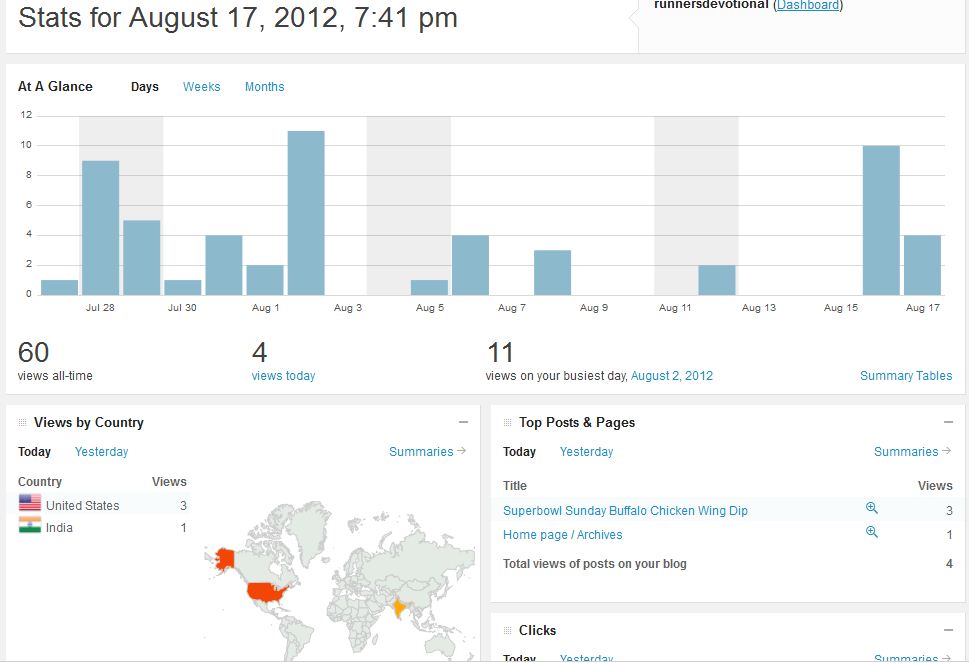
To me as a beginning blogger, the number of pageviews that I receive for each post is a simple yet important statistic for me. This statistic allows me to see which of my posts attracted the most views. I can then analyze that post and see what “lessons learned” I can carry over to future posts in order to attract more traffic. For example, the post which has attracted the most pageviews so far is my Buffalo Chicken Dip Recipe post, but I will need to do some deeper analysis to determine what made this post receive more traffic than the others. Perhaps, I did a better job of setting up my categories or tags on this post or perhaps it was the specific content of the post.
2. Search Engine Terms
Search engine terms tell me what key words people entered into Google or another search engine site that drove them to my site. Going back to my Buffalo Chicken Dip Recipe post example, I can see that all of the extra “hits” to this post (compared to me other posts) came from people searching on terms similar to “buffalo chicken dip”; consequently, I can tell that people were attracted by the recipe itself and not my introduction recounting the origin of buffalo chicken wings or from my tags which weren’t highly specific. This might lead me to post other favorite recipes if I can reconcile this type of post with the overall theme of my blog. Or….. maybe I should start a food blog instead of a running blog.
3. Social Media Shares
The number of social media shares will be an important measurement for me. Posting a link to my blog via my social media accounts (e.g. Facebook, Twitter, LinkedIn, etc.) when I make new blogposts is one of the easiest ways to attract traffic to my blog. Hopefully, those who come will want to retweet or reshare my posts. Recommendations from “trusted agents” is one of the key determinants of sales in the social media age; consequently, it’s important to see that my audience appreciates my content enough to share it with others. If my content isn’t being shared, then I know something is wrong and I need to determine what can be done to make my content valuable enough to share with others.
Identify tools and statistics to track and improve my blog’s numbers.
1. WordPress comes with a built in statistics tool. It shows most of the basic statistics that a beginner would want to track. It shows pageviews, referrers, search engine terms, top posts, and categories. I will be interested in tracking the number of page views per day, and per month to see if I am getting more hits on my site. I will also be tracking the top posts, so that I can try to determine what types of posts my audience is gravitating toward. I will be watching the referrals and search engine terms to see how people are getting to my site and where they are coming from.
2. Google Analytics
If I don’t feel I’m getting enough information, I will try another statistics tool such as the Google Analytics which would allow me to build my own custom reports. There is also a Google Analytics plugin for WordPress which would allow me to see these reports within WordPress.
3. Klout, Twitalyzer, and Peerindex
Klout, Twitalyzer, and Peerindex are tools that attempt to rate a person’s social media influence. Twitalyzer will produce a score based on the number of followers, references and citations of me, how often I’m retweeted, how often I retweet, and the relative frequency of my posts. It can also display my scores from Klout and Peerindex as well. The Klout score attempts to measures my influence across major social media sites. The Peerindex rating is a measure of my online authority or social capital that I have built up on the web. Although these ratings can be manipulated, and therefore make it difficult to truly compare one user’s influence to another’s, they can be useful in tracking your relative influence over time. I will use them to track my (hopefully growing) social media influence month by month.
4. Voice of the Customer Tools
OpinionLab, SurveyMonkey, and Zoomerang (now owned by SurveyMonkey) are examples of tools that could be used to survey readers and solicit their opinions on how what types of postings they are interested in and how to improve my blog. At this point, I need to focus on increasing the size of my reader base. I don’t have a large enough reader base to produce a sample size which would ensure reliable survey results; nevertheless, I hope to use this type of tool in the future to directly solicit reader input and improve my blog (and pageviews).

Identify one statistic you see as an issue for your blog and what you can do about it.
Right now just increasing my pageviews is my primary issue. Fortunately, there are lots of things I can do about it. Here is where I need to start:
1. Post consistently and regularly several times per week.
Anecdotally, my traffic seems to increase if I post regularly several days in a row. A 2011 study by some Standford graduate students who ran regression analysis on 100,000 blogs also showed that this was one of the top three ways to increase pageviews. Consistently putting out content on a regular schedule encourages readers to expect your posts and encourages them to keep coming back.
2. Write as to encourage comments.
The same Stanford study showed that the best blogs encouraged a dialog with their readers. This created a back and forth between the blogger and the readers which led to more comments and more page views. More comments led others to post, creating a virtuous cycle of more comments, followed by more pageviews, and additional comments.
3. Make it easy to follow.
The study also found that making the “follow” widget as visible as possible, made it more likely to be selected. This led to more return visits and more pageviews.
4. Promote new blogposts on social media.
Once I complete a blogpost there’s no reason not to let others know about it. Since I already have Facebook, LinkedIn, and Twitter accounts, I can easily share my posts with people who already know me and would have a potential inclination to read what I write.
 runnersdevotional